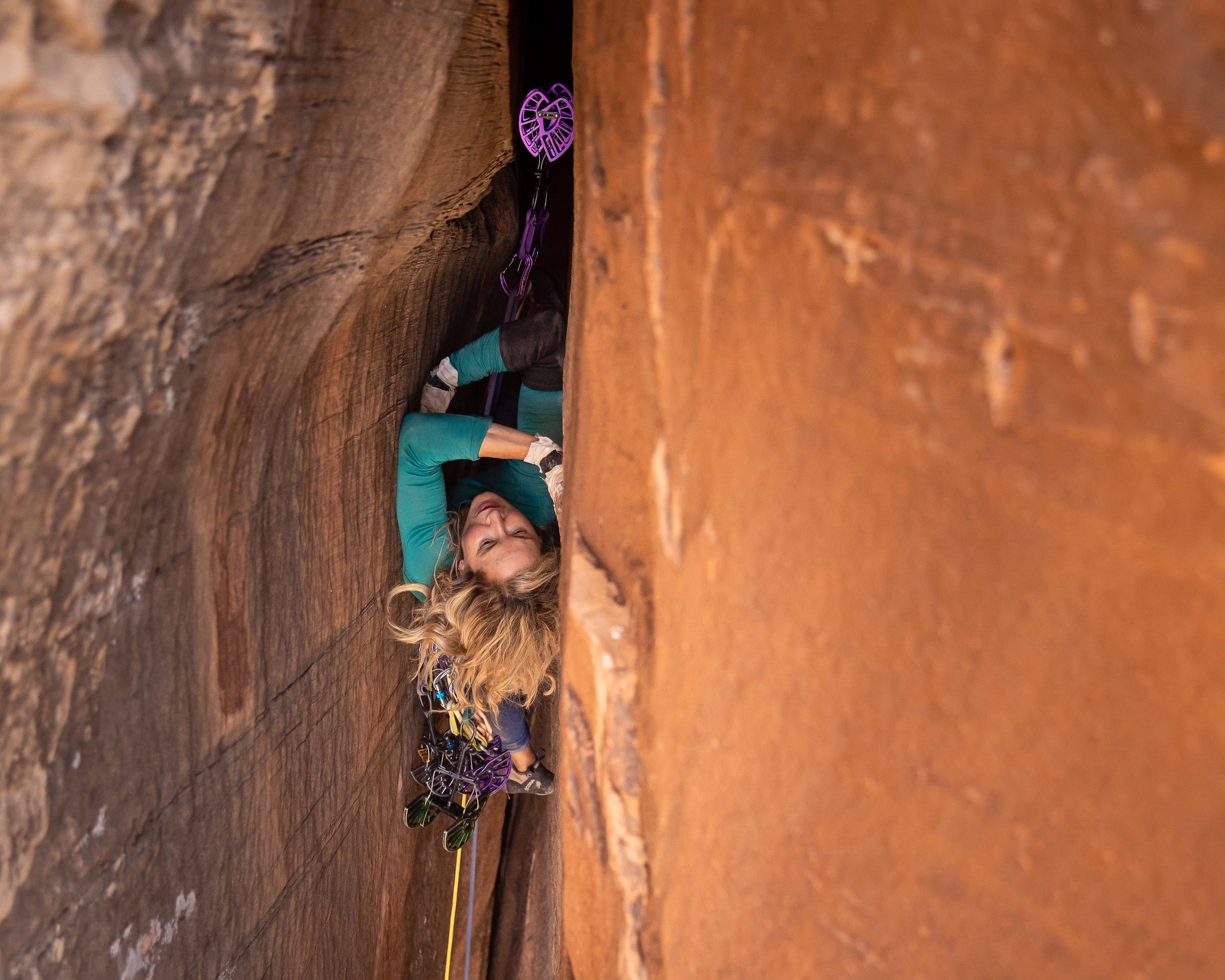
Training for Hard Offwidths

All climbing styles require a high level of fitness, but climbing vertical wide cracks is closer to alpinism than sport climbing. It’s not unusual to take more than an hour to climb a single pitch of 5.11 offwidth in Indian Creek, and with 10 to 20 lbs. of gear, it feels even more strenuous. A solid foundation of fitness will mean more success and less injury. I recently wrote a two part (12 week) offwidth training program for Climbing Magazine: ”Your Goal: Training for Hard Offwidths” based on my own training. Part 1 is in the May 2013 issue (Climbing 315) and Part 2 is the June/July 2013 issue (Climbing 316). There is also an online component which includes sample training programs and suggestions for the stabilization (core), stretching and plyos sessions:

Offwidth Training: Plyos
Offwidth Training: Stabilization (Core)
Offwidth Training: Stretching

I have more detailed versions of these sample training programs below and will be updating this section of my blog regularly with more suggestions as well as descriptions, photos, videos of the exercises and training specifically for inverted offwidths. Please feel free to contact me with questions regarding these programs and/or the exercises.

This article and training program couldn’t have been possible without a phenomenal team of trainers, coaches and Pilates Instructors involved in it’s creation. A tremendous thank you to PT, Leah P. Versteegen, MS, DPT, at Alpine Physical Therapy in Missoula, Montana who has rehabbed me through multiple major injuries, including dislocated ribs, ruptured discs and a torn ACL and designed and fine-tuned this training program with me over the past few years.  And a special thank you to  Samantha Schmidt, PT, CPI, CAMI/CAPT and Samantha Glaes also both with Alpine Physical Therapy who devised brilliant schemes to increase core strength for every offwidth technique I could throw at them from calf-locks to inverts. And finally thank you to Tim Brown — a triathlete and my trainer at The Peak Health and Wellness Center in Missoula, MT who devised many unique and creative ways to torture me for the sake of wide crack climbing including many of the plyometric exercises you see below.

Offwidth Training: Plyos

In Phases 1 and 2 of the 12 week program in Climbing Magazine aim for 30-minute plyometric sessions, then work up to two hour long sessions in Phases 3 and 4. Plyos are the most intense of the workout components and present the highest risk for over-training and injury, so start slowly and focus on proper form. After you have perfected your form in the earlier training phases, speed up the sessions and add additional reps. However, the emphasis should always be quality over quantity for all exercises. Expect some fatigue and muscle soreness after plyometric training, but if you are feeling excessively fatigued or sore drop back to one day a week or take an entire week off from plyos. Again, it is crucial to allow your body to recover in order to repair and strengthen tissue, as well as recover from energy loss. Without proper recovery time and good nutrition you will become weaker despite all your training efforts.
Use the workouts below to mix and match sets and exercises you want to try. Mix up the number of repetitions (e.g., 10, 12, 15 reps—or as many reps as you can do in 30 seconds to 1 minute) for the best effect between workout days. I usually try to complete 3 to 4 sets of 8 exercises in one hour. Generally, I perform the same number of repetitions (for example, 15) in one session and another session will try to do as many repetitions as possible while maintaining good form for each exercise for 30 seconds to 1 minute.

Another technique is to start a session with 45 to 60 seconds of a high-intensity exercise (such as squat jumps), followed by one minute of a challenging exercise (box pushes), and then switch to exercises of 15 reps. This more closely resembles offwidth climbing and provides variety to the training routine. Towards Phase 4, I perform “bookend” sessions by starting with one minute of a high intensity exercise (box pushes or box jumps), then proceed with another six core-based exercises (such as ring rows, ring Y’s, ring I’s, ring T’s), and complete the set with another higher-intensity set (squat jumps) for 30 seconds to one minute. Rest for a maximum of a few minutes between sets. I have included sample workouts below:

Exercise / Equipment

  • Spiderman plank / Mat : Assume a standard push-up position. Begin exercise by bringing your left knee to your left elbow. Return to starting position and repeat with the right side.
  • Hanging windshield wipers (advanced) / Pull-up bar :  Hang from the pull-up bar  with the legs  straight, hips bent, torso leaned back and toes near the pull up bar. Slowly and under control move your feet from side to side along the pull up bar.  Your legs should remain straight as you twist your hips and abdominal muscle will twist  from side to side.
  • Inverted ring pull-ups / High rings and wall: Hang from rings attached to a pull-up bar. Flip upside-down and hook your toes over the pull-up bar. Perform pull-ups from this inverted position. This is more useful for inverts than vertical but also helps build heel/toe strength.
  • Russian twist with medicine ball / Medicine ball
  • Ring or TRX rows / Low rings or TRX
  • Ring Spiderman planks / Low rings
  • Single-leg hamstring bridges / Mat and Swiss ball
  • Offset push-ups on medicine ball / Medicine ball
  • Ring I’s (advanced: feet on Swiss ball) / Low rings
  • Ring Y’s (advanced: feet on Swiss ball) / Low rings
  • Ring T’s (advanced: feet on Swiss ball) / Low rings
  • Ring push-ups (advanced: feet on Swiss ball) / Low rings
  • Offset ring pull-ups / High rings
  • Towel body-weight row / Smith machine and two towels
  • Oblique abdominal curls / Medicine ball
  • Swiss ball roll-outs on foam roller / Swiss ball and foam roller
  • Forward jumps from standing / Floor
  • Battle ropes rope-pull from push-up position or seated position / Battle ropes
Battle Ropes

Battle Ropes push-up position

  • Squat jump / Floor
  • Medicine ball forward throws from knees  / Medicine Ball
  • Medicine ball throws overhead / Medicine Ball:  Throw medicine ball as high as possible, let it bounce, grab it and repeat.
  • Medicine ball oblique toss (right and left, from knees) / Medicine ball
  • Skater jumps (side to side) / Floor
  • Medicine ball rebound throw (throw at wall, let it bounce, grab it) / Medicine ball and wall
  • Battle ropes alternating wave / Battle rope
  • Single-leg squat jumps / 12″ box for back foot :  Perform singe leg squat jumps on front foot with one leg behind you on the box.

Sample 60-minute Stabilization workout with Plyos: Three Total Sets

Set 1: Plyos (30-60 seconds each)

  • Squat jumps
  • 12-15 lb. medicine ball:  throw overhead as high as possible, let it bounce and grab it.
  • 12-15 lb. medicine ball: throw at wall, let it bounce and grab it.
  • Skater jumps (side to side)
  • Battle Ropes (alternating waves)
  • Single leg squat jumps (one leg on bench behind you and perform squat jumps on front foot)

10 reps for the following:

  • Offset pull-ups on rings (each side)
  • Spiderman planks (each side)
  • Side ball curls on Swiss ball (each side)
  • Ring flies
  • Ring back extensions
  • Medicine ball passes (On back, pass ball between feet and hands.)

Set 2:  Repeat plyos as above, then sets of 12 for the following:

  • Offset pull-ups on rings (each side)
  • Spiderman planks (each side
  • Side ball curls (each side)
  • Ring flies
  • Ring back extensions
  • Battle-rope cross-overs (30 sec)
  • Medicine ball passes

Set 3: Repeat plyos, then the following:

  • Offset pull-ups on rings (10 each side)
  • Spider man planks (20 each side)
  • Oblique abdominal curls on medicine ball (20 each side)
  • Ring Flies (20)
  • Ring Back extensions (20)
  • Battle-rope cross-overs (30 sec)
  • Medicine ball passes (20)

Nutrition before plyos:  Eat a snack 1 hour before a plyos session that includes water and carbs to fuel your muscles. After the workout, do the same but add protein to help with recovery. Give your body ample time to recover after an intense plyos workout before you begin a new workout. Experiment with what food works best for you. I eat one half of a Clif Builder’s Bar one hour before plyos and drink the Clif Shot Electrolyte Drink during training. After hard sessions I will drink a protein shake: banana, Greek Yogurt and almond butter is my favorite. Greek yogurt has plenty of protein without adding a protein supplement.

Offwidth Training: Stabilization (Core) Exercises

Offwidths require strong abdominals, back, and hips. There are multiple options for stabilization/core training. Choose at least two to three core workouts per week throughout each cycle outlined in Climbing Magazine. If possible, take a small class 1 day/week with an instructor to monitor your form. Most of your stabilization (core) training will be covered by your plyometric sessions in Phase 3 and 4 as outlined above.

Ideas for non-plyometric core sessions include:

  • Pilates (Reformer, Cadillac, Mat etc.)
  • CoreAlign
  • Core group fitness classes

If you can’t get to a class or are short on time, choose one of these series:

Series 1

  • Abdominal roll-ups x 15
  • Planks, 3 x 1 min
  • Side plank with leg lift, 2 x 30 sec (each side)
  • Upper abdominal crunches x 100

Series 2

  • Ball plank, 3 x 1 min
  • Ball side crunch, 2 x 30 sec (each side)
  • Ball forward crunch x 100
  • Ball walk-out x 15

When you build a base core strength, up the ante by making your stabilization/core sessions longer. Here’s a 60-minute sample session (2 sets of 15 reps for each):

  • Planks with alternating arm circles
  • Rings: mid-back extensions (straight arms pulled back)
  • Ring push-ups
  • Ring Y’s
  • Ring T’s
  • Hamstring bridges with alternating single foot on medicine ball
  • Medicine ball forward toss (from knees)
  • Medicine ball side throws (both sides and from knees)
  • Towel alternating track runs in place (30-60 seconds)
  • Ring abdominal crunches (start in push-up position with feet in rings)
  • Single-leg step-ups onto box
  • Planks on elbows with rotation left and right

Other options: Ring flies, ring back extensions, ring rows, single-leg balances on Bosu Ball, side planks, TRX exercises etc.

Offwidth Training: Stretching

Stretching is an important component of a complete conditioning program. Regardless of your starting flexibility level, as you gain muscle mass and strength it is crucial to promote and maintain mobility. Naturally the more mass a muscle has, the stiffer it becomes, so as you enter a strength and conditioning program,  stretching is necessary.  The more elasticity (or flexibility) a strong muscle has, the more power it can generate through a greater range of motion. Before training and/or climbing avoid static stretching which is detrimental to sports involving powerful movements. Dynamic stretching before training increases movement of the joints through a specific range of motion and helps to increase core temperature, blood flow and wake up the central nervous system. Recent research indicates that dynamic stretches also improve force production and explosive power.

My coach and PT, Leah Versteegen explains: “Whether your stretch is static or dynamic be sure to focus your movement to the desired joint(s) you are aiming to stretch.  Your body adheres to the laws of physics and will follow the path of least resistance when stretching. This means that if you are stiff at a particular joint then your body will naturally want to move somewhere else during a stretch, thus making the stretch useless in improving the desired joint flexibility.  For example, if you want to stretch your hips, be sure you core is solid to prevent your lumbar spine from moving too much during the stretch.”

Spend 5-10 minutes on a stationary bike, elliptical, light jogging or hiking to prepare your body for dynamic stretches. Perform a series of 15-20 repetitions of each dynamic stretch. Examples include: leg swings side to side (hip abductors and adductors) and front to back (hamstrings and hip flexors), walking knee tucks (glutes and low back), walking power kicks (hamstrings), walking lunges with and without a rotation (hip flexors/ spine with added rotation), sideways walking with squats (hips), full arm circles (deltoids, trapezius, shoulder capsule), arm swings across the front of your body and back (scapular muscles, pectorals) and side bends (obliques and quadratus lumborum).

After training and/or climbing perform a series of major muscle group static stretches for maintaining and increasing flexibility. Major muscle groups include calves, hamstrings, quads, hip flexors, hip rotators and adductors, abdominals, paraspinals (muscles along the spine), pectoralis, lats, and traps.  Hold stretches for 20-30 seconds each. In addition to the major muscle groups an additional Thoracic spine and Pectoralis stretch series performed on a foam roller is beneficial to climbers who tend to have tight pectoral muscles and limited flexibility in the Thoracic spine. The foam roll can also be used for the dreaded IT Band which can cause serious low back pain, hip pain or knee pain if too stiff. Lay on your side on the foam roll with it perpendicular to your outer thigh. Roll up and down on the foam essentially using it like a rolling pin to loosen the IT Band.

Foam Roll Supine Thoracic Spine and Pectoralis series:

  • Thoracic Spine – Extensions x 15
  • Thoracic Spine – Reaching Over your Head x 15
  • Thoracic Spine – Opposite Arms Reaching x 15
  • Thoracic Spine and Pectoralis Stretch x 15

Foam roll supine shoulder series:

  • Snow Angels x 15
  • Goal Posts x 15
  • Overhead reach x 15

Other stretches:

  • Thoracic-spine roll-out on foam roller x 1 minute
  • IT band roll-outs on foam roller x 2 minutes
  • Standing side-bends, 2 x 30 seconds
  • Child’s pose, 3 x 20 seconds

Offwidth Training: Maintenance

During the climbing season it is beneficial to follow a maintenance training program outlined below:

DURING   CLIMBING SEASON
STRENGTH 1-2x/week at 70% RM  (2-3   SETS of 15-20 Reps)
STABILIZATION   (CORE) – Plyos 1x/week
STABILIZATION   (CORE) without Plyos 1-2x/week
CARDIO See Below
STRETCH Every other day

Cardio:  How much cardio you do will depend on how much you are climbing. Cardio will complement your climbing days and approaches. Aim for 2 days/week moderate cardio (45-90 min, one of which can contain intervals) in addition to 3-4 days/climbing for a total of 5-6 days of cardio. Again, make sure you have one full rest day/week with only light stretching.

Note: When I am climbing hard offwidths with 45-60 minute approaches 4-5 days per week I only add one session of isolated core without plyos and stretch every other day.

FA of The Forever War, Vedauwoo, WY

Edelweiss Ropes U.S.A. and Liberty Mountain present Pamela Shanti Pack on The Forever War 5.13+ R in Vedauwoo, WY.

Thank you to Edelweiss Ropes USA and Liberty Mountain for your tremendous support and outstanding ropes. I had a great time making this video with Nathan Smith. Check out more of his amazing work at Pull Photography.

Note: A few people have asked me about the bolts on this route as well as the “R” rating. There is almost always the potential for slamming back into the roof and/or the ground when falling out of inverts.  However, that in itself never warrants an “R” rating in my opinion as it’s quite obvious when looking at the route.  In this case, I wanted people to be aware that there is dangerous fall potential precisely because it looks as if there isn’t any. If you happen to fall while clipping bolt one or bolt two or placing a piece just past bolt two you will likely take a header into the ledge and this isn’t apparent from the ground.

Also, I am regularly asked why I don’t wear a helmet. I would love to wear a helmet but more often than not I can’t fit in the offwidth with a helmet!

Read more about the route and Vedauwoo here!

Vedauwoo, WY: Pretty Damn Offwidth!

It’s been an awesome few weeks climbing wide cracks in Vedauwoo, WY. Vedauwoo is where I first started climbing wide cracks so it feels like home — granite crystals ripping up my back, battling to stay in the flared Sherman granite cracks, crawling under barb-wire fences and all the while the sound of gun-shots in the background. Vedauwoo is renowned for some of the most physically demanding and painful wide crack climbing in North America.

Pamela Shanti Pack loading the clip on The Forever War, Vedauwoo, WY Photo: Zach Orenczak

The Forever War is an 85-foot pitch featuring 20 feet of inverted climbing through a steep roof, followed by overhanging arm-bars capped by 30 feet of 5.12a blue-collar groveling.  Despite the two bolts, the route still requires a hefty rack.

Pat had told me about the stunning inverted roof project he found last fall. After describing it as the most “agonizing, miserable, difficult and maybe impossible” invert he’s attempted I was convinced I was going to love it. However, standing at the base of the roof I started feeling queasy. I came up with the regular excuses for avoiding the route — I’m out of shape, my back hurts, I forgot Motrin and, well, it looks impossible. I taped my hands for the next hour, took knee pads on and off, and nervously changed color shirts a few times. We agreed this was not a good route to attempt to onsight as the roof is leaning about 40 degrees. Inverting at this angle means a fall will result in a dangerous slam to the head.

Pamela Shanti Pack at the crux of The Forever War, Vedauwoo, WY

After the first moderate 30′ of climbing on the new project I was wedged into a squeeze chimney of sorts directly below the 25′ roof trying to figure out how to get inverted. I couldn’t get a solid fist stack to invert off.  I managed to invert by leaning off the back wall and gracefully smearing off the side of my head. I climbed it cleanly on top rope on my second attempt but red-pointing was intimidating.

We added two bolts to the route after a fall put me in the hospital with a damaged kidney. After five days in the hospital, nine days in bed, two surgeries and 100 episodes of Nip and Tuck I returned to Vedauwoo against my doctor’s recommendations.  I quickly dispatched of Simianatics and 8 Ounces to Freedom both V9 and considered two of the most difficult two invert offwidths in Vedauwoo. After repeating those hard inverts I concluded I was healthy enough to get back on the project. I was super relieved to finally red-point the route after one more spectacular whip from the crux.

I’ve climbed nearly every test-piece offwidth roof in Vedauwoo: Lucille (5.13a onsight), The Wing (5.12c first free ascent), Spatial Relations (5.13a first ascent), Trip Master Monkey (5.12b) and Squat (5.12b). The Forever War is more difficult for me physically and technically than any other route in Vedauwoo.

My favorite part of the route is the kick-over into the inversion which requires a head smear off the flake—pretty damn offwidth!

Pamela Shanti Pack fighting The Forever War, Vedauwoo, WY Photo: Pat Kingsbury

The highlight of the last week was certainly climbing and drinking margaritas with the un-stoppable Matt Kuehl and his lovely companion Molly Chambers. Matt’s one of the most enthusiastic and talented wide crack climbers I have ever had the pleasure of roping up with. Molly also happily chicken-winged into the sordid world of painful wide cracks and is now an official offwidthie! Read more about our week on Matt’s awesome blog: Vedauwoo Madness

Matt and Molly livin’ it up in Laramie

Matt could not be sand-bagged. On his last day in Vedauwoo we put Matt through his offwidth graduation test – Penetration (5.9+ notorious sand-bag), The Unicorn Exterminator (5.10c) and finally, The Empty Suit (5.12a) but he staggered away relatively unscathed and smiling. The highlight of Matt’s trip for me was belaying him as he established a burly and beautiful new route — The Gates of Eden (5.10a) — a classic blue-collar wide crack — arm-bars, knee-jams and Big Bros. Yeaaaaaah Matt!!!

Matt Kuehl crushing it on the FA of The Gates of Eden 5.10a Photo: Pat Kingsbury

Matt Kuehl on Part I of his three part offwidth graduation, Penetration 5.9+ Photo: Pamela Pack

The bad-ass Molly Chambers gettin’ it done on Right Parallel Space Photo: Pamela Pack

Iron Maiden 5.11b and Lucille 5.12d/13a

I also coerced Pat into repeating Andy Johnson’s ridiculously sand-bagged offwidth test-piece the Iron Maiden (5.11) on John’s Tower in Vedauwoo, WY in preparation for Lucille (5.12d/13a). I have repeated both Iron Maiden and Lucille myself and have to agree with Andy that the routes are quite similar. Whether this means they are both 5.11 or both 5.13 is for you to discover for yourself.  They are both vomit-inducing, agonizing squeeze chimneys — both damn challenging and well worth your time if you are a masochistic soul.

So, Pat procrastinated for an hour at the base of the route and eventually crawled back into the cave to start climbing. As he was about to place his first piece his cell-phone beeped and he gleefully announced: “I got an email from my mom!” Ah another chance to procrastinate. Despite Pat’s extraordinary attempts to put the route off until it got dark out he finally managed to crawl out the roof and onsight it. And I mean actually crawl. For the first ten feet of Iron Maiden it’s necessary to wedge one knee on a ledge and creep out it dragging your left leg across sharp crystals. Part way through the seemingly endless bloody pivot Pat announced: “I don’t feel so good.” Eventually he rapped off from the anchor, curled up in a ball at my feet and stated: “That HURTS.” I didn’t mention beforehand that I’d taken a week off after sending Iron Maiden myself with my shirts stuck to the oozing wounds on the back of my shoulders and a bottle of antibiotics by my side.

The Glass Hummingbird

The Glass Hummingbird 512+ Photo: Matt Kuehl

Pat has had a bit off offwidth ADD on this trip however, we were able to get him to focus long enough to establish “The Glass Hummingbird” (5.12+). This route starts with steep, flared hands to a painful offwidth exit. The crux is a dyno from a tight flared hand to a chicken-wing. The route was named for Zach Orenczak and Rachel Lynn who are a constant source of entertainment and inspiration with an impressive list of FAs in Vedauwoo. Their fantastic guide-book – The Voo: Rock Climbing in Vedauwoo – is a testament to their creativity and awesome sense of humor.

Simiantics, Vedauwoo, WY  Photo: Matt Kuehl   http://www.mattkuehlphoto.com

Outside TV Athlete Profile: About the Routes and Training

Thanks to Sender Films for making such a cool profile for Outside television. It was a joy to work with all of you despite the fact that you made me hang- upside-down on an offwidth roof 200’ off the deck waiting for the cloud cover and snuck up on me at 7am in the morning while wearing tiny shorts.


About the Training Footage

People have asked me about the weight-vest I am wearing in the training segment. It’s the HyperVest PRO from Hyperwear. I am 105lbs and train with a 20lb weight vest for offwidth climbing. I do all my strength training and metabolic training including Plyometrics wearing the weight vest to simulate the rack I carry on wide cracks which can often be nearly 20lbs. I have tried a few vests but the HyperVest Pro has a better fit and keeps the weight more evenly distributed throughout my core rather than on my shoulders. Not only is it more comfortable and less bulky than other vests it even looks pretty damn stylish.

I am also using the TRX Suspension Trainer in the video which is very effective for core and shoulder stabilization in climbers. There is no footage in the video but I also spend 4-5 days a week doing Pilates. The Pilates Cadillac is fantastic for training for the super casual, contorted foot-over-your-head positions required for the inverted style of offwidth climbing such as on The Event Horizon (5.13) which  is also featured in the video. Fortunately, the video does not capture me falling out backwards and upside-down while clipping — with my knee stuck in the crack and wacking my head.

At the point of no return on The Event Horizon 5.13 in Indian Creek, UT Photo © Andrew Burr

The Dark Passenger 5.12

‎”…it’s there always, this Dark Passenger. And when he’s driving, I feel alive…” ~Dexter

The wild vertical offwidth footage was taken on The Dark Passenger (5.12 FA) which Pat Kinsbury and I established this last fall in Long’s Canyon just outside of Moab, UT. The Dark Passenger is the epitome of blue-collar American wide crack climbing. It will crush your ego and steal your soul.

Pamela Shanti Pack defying The Dark Passenger 5.12 Long’s Canyon, UT Photo © Andrew Burr 2011

I first noticed the stunning line while on a pilgrimage to repeat the late Craig Luebben’s (1960-2009) top ten desert offwidths as a tribute to him as it was the analog crack to his visionary Dragon’s Lair 5.11. I imagined that Craig might have walked up to the Dragon’s Lair beckoned by this intimidating, wildly twisting 500’ analog crack replete with a 200’ of unprotected squeeze chimney that dominates Dead Man’s Buttress in Long’s Canyon. It would be my final tribute to Craig.

The Dark Passenger 5.12 Long’s Canyon, UT Photo © Andrew Burr 2011

We spent two weeks cleaning the route wearing safety goggles and dust masks. I even modified my windshield scraper to reach into the crack to scrub it. We trundled a few tons of rock including a 16′ pillar after putting a bolt ladder around it. The climbing itself is painful and creative with the highlight for me being 20’ of a razor sharp, unprotectable, 8″ offset, inwardly flaring 6″ crack and another 30′ of the “squiggles” — a wildly twisting helix that requires horizontal hand-fist stacks. I described the route to Kennan Harvey, a frequent partner of Craig’s, who responded: “Number 11 route sounds like a melding of all the wiggling. Craig would be dancing.”

Read more about my pilgrimage to repeat Craig Luebben’s routes in Climbing Magazine: Craig’s List.

Serrated by The Dark Passenger 5.12, Longs Canyon, UT Photo © Andrew Burr 2011

I finally deemed the ominous route The Dark Passenger  – a concept used in the TV drama Dexter to represent the demon  in each person’s soul that can either control them or be controlled. Repeat the route and decide for yourself who is in the driver’s seat.

The Dark Passenger 5.12 is the center line splitting the formation to the rim.

The Dark Passenger 5.12, Long’s Canyon, UT is the line on the right.

Climbing Upside-Down: The Invert

"Leavittation" invented by Randy Leavitt and Tony Yaniro

Whyclimb upside-down? Is it masochism, is it fun or is it simply a 5.17 circus-trick? Well, all of the above but it is also necessary in order to surmount offwidth roofs. How is it possible to climb out a roof crack that is offwidth – that is too large for a fist jam and too small to chimney? When it is necessary to resort to hand/hand or hand/fist stacking in a roof it’s usually time to “invert.”Inverting requires getting your feet above you head and hanging upside-down by them allowing the climber to advance their hand-stacks across the roof. It will depend upon your hand, fist and foot size when you need to invert, but most climbers  need to invert when the roof is approximately 5″ wide.

There are various methods for inverting and they are all core intensive. And then there are various methods for pivoting, getting right-side up again, as well as moving while inverted.  All methods of climbing inverted are based on a technique developed by Randy Leavitt and Tony Yaniro referred to as “Leavittation.” Yaniro and Leavitt developed the technique in order to surmount the infamous 5″ roof-crack Piasano Overhang, Suicide Rocks, CA in the 1970s.

Invert Methods

There are a few methods for inverting. One of the most common method of inverting, or kicking-over, is off of a hand/fist or a fist/fist stack.  Kicking-over requires a bit of momentum and a lot of core strength. It’s easy to rely on your hip-flexors for power while inverting but this movement it predominately instigated from your lower abdominal muscles. Activating your lower abs not only gives you more power to invert but also protects your lower back. I recommend that when learning to invert you start on offwidth boulders as placing gear while inverted is a bit perplexing.

Matt Kuehl demonstrates a full-inversion while Offwidth bouldering
http://mattkuehl.blogspot.com/

In the sequence below I am getting inverted on Spatial Relations  in Vedauwoo, WY. I place my gear in front of myself in case I fall right out of the inversion (but not so that it will be in the way of my feet), get a solid hand/hand stack and kick-over. As soon as my feet are wedged above my head I can drop my hands out of the crack and rotate my upper body to the other side where I can continue to pivot right-side up.

Image 1: Placing gear in preparing to Invert on Spatial Relations, Vedauwoo, WY Photo: Tom Kingsbury

Image 2: Setting up my hand/hand stack on Spatial Relations, Vedauwoo, WY Photo: Tom Kingsbury

Image 3: "Kicking Over" on Spatial Relations, Vedauwoo, WY Photo: Tom Kingsbury

Image 4: Getting a solid heel/toe placement. Spatial Relations, Vedauwoo, WY Photo: Tom Kingsbury

Image 5: Pivoting around my feet and advancing my hands. Spatial Relations, Vedauwoo, WY Photo: Tom Kingsbury

Here is an excellent example of  kicking into an iversion as demonstrated by Kris “Odub” Hampton on Trench Warfare 12d.

Kris "Odub" Hampton getting inverted on Trench Warfare 12d, UT

There are other methods of inverting: it’s possible to invert off of a chicken-wing placed over your head. A chicken-wing is a common technique for climbing offwidth cracks in which you  insert your arm bent at the elbow into the crack and use counter-pressure between your palm and the triceps to remain in the crack.

Climbing out Gabriel 13c on a chicken-wing. Photo: Jim Thornburg

For more about climbing inverted see:

Matt Kuehl: Life Inverted
Leavittation: The Offwidth Renaissance

Injuries: Chronic Exertional Compartment Syndrome (CECS) in Rock Climbers

There are a handful of questions I am asked repeatedly as a climber specializing in wide crack climbing in particular inverts. These questions include: why do climb upside-down, how do you get upside-down, how do you get right-side up and why do you climb nothing but offwidths?

Why do I climb only offwidths?

Well, I don’t climb only offwidths. How many times have you walked up to a crag and seen 100’ much less 1000’ of pure offwidth? There are inevitably long sections of finger cracks, hand cracks and even moments of crimping between sections of wide cracks. Of course I am overjoyed when cleaning a new route and a pillar with a splitter finger crack collapses leaving a dirty squeeze chimney in its place. I’d been climbing for over ten years, avoiding wide cracks like everyone else until 4 years ago when I made the transition to the sordid world of wide cracks. And it wasn’t exactly by choice.

Chronic Exertional Compartment Syndrome (CECS)

Over a particularly obsessive winter of mixed climbing and bouldering I developed chronic exertional compartment syndrome (CECS) in my forearms. I thought I was getting pumped and needed to train more but the more I trained the more painful my forearms became. Finally, it got to a point where I needed help prying my hands off my ice-tools and I started having difficulty with fine motor skills. And the pain was excruciating. I decided it was time to see a doctor and ultimately consulted four surgeons.

CECS is a serious condition that involves increased pressure in a muscle compartment. It can lead to muscle and nerve damage and problems with blood flow. My diagnosis was confirmed by measuring the pressure in the compartments of my forearm using a needle attached to a pressure meter which was inserted into the compartments. My compartment pressures exceeded 35 mg Hg. After conservative approaches to treat the CECS failed (anti-inflammatories, physical therapy, sports massage) my surgeons agreed that because my case was so severe I had two options: quit climbing or have a fasciotomy.

The fasciotomy involves making incisions in the skin to expose the fascial covering over the muscle compartments. The fascia is released, and the skin is closed outside of the muscle compartments. This procedure gives the muscles room to swell, alleviating pressure on the nerves and blood vessels. I only personally know of one climber who had the fasciotomy years ago and was not happy with the results but the surgery had been performed successfully on many athletes.

CECS Forearm Fasciotomy: Volar Incision Method

I opted to quit climbing due to the considerable risks and scarring involved in the surgery as well as questionable long-term prognosis. I was especially concerned about scar tissue causing more damage. My climbing “retirement” lasted for approximately two months when I discovered that wide crack climbing — due to it’s full body nature — is less forearm intensive for me than sport-climbing, ice-climbing and/or bouldering. And so I was able to continue climbing in this style. I am able to boulder, sport-climb and climb finger cracks to a very limited extent as well. I still have problems with the CECS and avoid training my forearms as much as possible.

Pamela Shanti Pack, not crimping on Lucille 13a, Vedauwoo, WY Photo: Jim Beissel

More information on CECS:

I will continue updating these links and including additional information in the future. I have a friend who is planning of having the procedure on both arms to prevent the forearm pump he experiences as a motocross racer.

Offwidth Beatings and Thrashings

Offwidth climbers have the reputation for being bad-asses who take joy in pain and suffering. So, this winter when the nurse asked me if I wanted a sedative before a cortisone injection for a severely herniated disk at L4-L5 I opted out. As she set up an IV the doctor explained to me: “We need to inject this cortisone in a very small space and there is a good chance of nicking the nerve with the needle. If I hit that nerve you’re gonna get a pretty damn good zing down your leg.” I immediately asked for the sedative in addition to pain-killers and anti-nausea drugs. And, I spent the rest of the day lying on an ice-pack in pink flannel pajamas with a bottle of codeine by my side. Why do I continue to seek out the world’s widest and most physically grueling crack climbs?

Pamela Shanti Pack's Bloody Hands after a long day n Vedauwoo, WY

Wide cracks require some of the strangest, most physically demanding and painful techniques in all of climbing. We wide crack climbers perform grueling sequences of hand stacks, knee-locks, armbars, chicken wings, heel-toes, calf-locks and inversions in order to surmount the world’s most despised cracks. We make desperate attempts to minimize pain with long-sleeve shirts, high-top shoes, knee-pads, elbow-pads and tape gloves but the sharp granite crystals of Vedauwoo rip up our hands and the relentless desert cracks leave us hyperventilating and trying not to vomit. Our heavy racks get wedged behind our thighs, our big cams tip-out leaving us 40’ above our last piece and on a particularly bad day we may get a foot stuck over our head for long enough to consider removing it Aron Ralston style. 

Pamela Shanti Pack after climbing Stout 5.12 in Indian Creek, UT Photo © Nathan Smith

Despite the fear and pain I have dedicated years to obsessively seeking out the most relentless and agonizing offwidths and squeeze chimneys.  I have suffered countless bruises and fractures.   I have lost teeth in Vedauwoo, knocked myself unconscious, dislocated ribs and inhaled infectious spores.  I wake up in the middle of the night with abrasions, from hours of scouring my shoulders across the sand-stone, stuck to the sheets.

I am often asked — why do you continue to climb wide cracks? Is it obsession, is it masochism, is it self-hatred, was I fed something strange as a child, did I suffer some child-hood trauma? I climb offwidths because they are my missing puzzle piece, the intellectual challenge, the ability to overcome physical pain, the elegance of the movements, the powerful nature of the routes, the mental and physical commitment  — it’s in my soul, it’s where I am at peace.  It’s my joy, it’s my torment. They are the source of my finest moments.

And for those who still do not understand all I can say is that: “Those who danced were thought to be quite insane by those who could not hear the music.” ~Anne Louise Germaine de Staël